< Research
April 2, 2026

Building an LLM powered application doesn’t really end when you deploy it. That’s when you start asking questions. You need to analyze outcomes and understand what the system is actually doing. Why did the model give that answer to a specific input? Which prompt works better? How does output quality change depending on the metric?
Without observability, you are mostly guessing.
In the past year, the LLM observability space has grown a lot. A year ago Langfuse was the default answer for the best alternative of LangSmith. Now, the landscape has become crowded and there are several serious options.
While choosing a suitable platform for our own use, we focused on three platforms that kept coming up: Langfuse, Opik and Langwatch.
All three have emerged as strong options for self-hosted, production-grade LLM observability. They are open-source, can run on your own infrastructure, and cover the basics: tracing, evaluation, and prompt management.
The real difference is in how they approach these problems and the architectural and product choices they make.

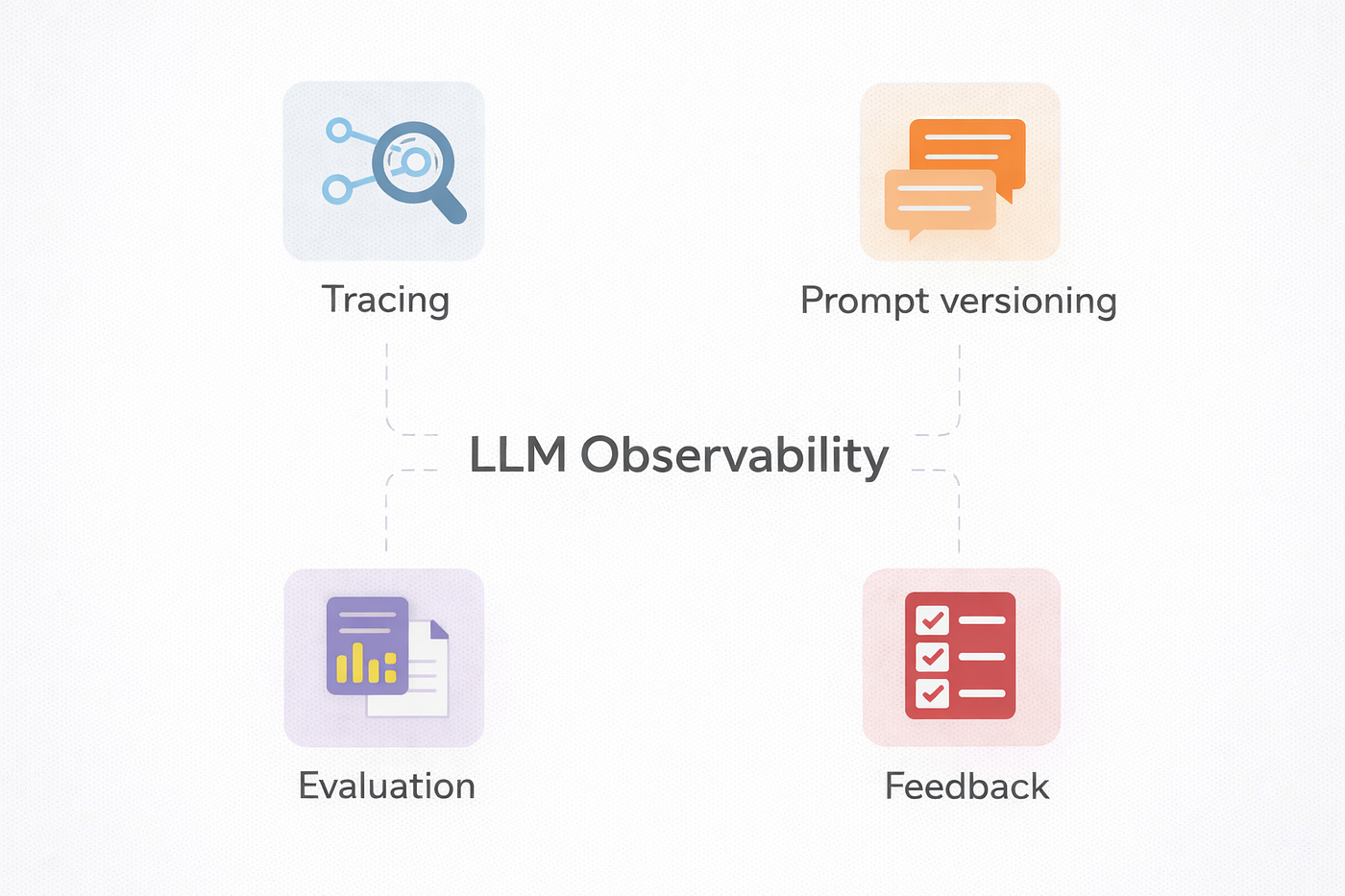
Before comparing tools, it helps to clarify what we expect from an LLM Observability platform. For me, there are three main things:
Langfuse is the most widely known and used platform. It is mature, widely adopted and production-proven. It has been around long enough to earn trust of many developers. The tracing is thorough, prompt management is among the strongest in the category, and integrates with many tools such as LangChain, LlamaIndex, and OpenTelemetry.
If you search for LLM observability platform comparisons, Langfuse comes up in almost every thread with being described as the “safe bet.”
The platform follows an open-core model: the core is MIT-licensed, but some additional features may require a license key. For most self-hosted use cases this isn’t a problem, but teams expecting a fully unrestricted open source experience should double check their feature boundaries.
Strengths
Weaknesses
The Infrastructure Situation
This is where we discussed whether Langfuse was the right option for us. A full production self-hosted deployment requires Postgres, ClickHouse, Redis/Valkey, and an S3-compatible blob store. That’s five separate services before your application even starts.
“Langfuse’s local installation is an insult — docker-compose feels like mini AWS.”
— r/LLMDevs, March 2025
The architecture isn’t arbitrary, ClickHouse is what enables fast analytics at scale. But for teams that don’t need that analytical depth, it brings overhead and real operational cost. In practice, this was one of the main trade-offs we had to consider.
Built by Comet ML, Opik positions itself as an evaluation-first platform and delivers meaningfully on that promise. Opik is one of the platforms most frequently mentioned alongside Langfuse in community discussions, and for good reason. It covers the same core areas (tracing, evaluation, prompt management, experiment tracking) while focusing more on automated evaluation pipelines. The ability to run evals like unit tests, integrated with pytest and CI systems, is a real differentiator for engineering-driven teams.
The platform is Apache-2.0 licensed, which is cleaner from an open-source compliance perspective than Langfuse’s open-core model. There is also a managed cloud option via Comet for teams that don’t want to self-host.
Even though Opik is relatively new compared to other alternatives, it has quickly become a serious competitor to Langfuse. However, its relative newness still raises some questions around reliability and overall maturity.
Strengths
Weaknesses
Self-hosting note: Opik’s local Docker setup is documented as development/demo only. For production use with proper access control, the official path is a Kubernetes deployment. Additionally, anonymous usage statistics are collected by default — disable with OPIK_USAGE_REPORT_ENABLED=false. Teams in regulated environments should verify telemetry behavior before deploying.
Langwatch is the most distinctive tool among the three. It is purpose-built for agent simulation and CI/CD regression testing. It occupies a different space compared to Langfuse and Opik. Its standout capability is simulation-based multi-turn agent testing: you can define synthetic user personas, run your agent through scripted conversation scenarios, and catch regressions in continuous integration before they reach production. No other platform in this comparison supports this as naturally as Langwatch.
The development workflow it enables (trace → dataset → evaluate → optimize → retest) is compelling for teams building complex, multi-step agentic systems whether a change has impacted conversational quality. This becomes especially valuable as agent behavior gets harder to reason about over time.
Strengths
Weaknesses
License note: Langwatch’s platform repository uses a Business Source License (BSL), which the license text explicitly states is not an open-source license. Some components (like the Scenario testing library) are MIT-licensed, but the core platform is not. Teams with open-source compliance requirements should evaluate this carefully before committing.
For teams where hosting cost and operational simplicity matter, the infrastructure of these platforms is worth examining directly.
The following figures come from a real benchmark comparing idle self-hosted deployments of each platform. These tests were run locally on my own machine to get a clearer picture of their baseline resource usage.

Opik’s higher RAM footprint reflects its ClickHouse-based analytics architecture, similar to Langfuse — it’s a capable stack, but not a lightweight one.
Langwatch’s lean profile comes from its simpler storage layer (OpenSearch + Postgres), which trades some analytics depth for a much smaller operational footprint.
Langfuse sits somewhere in between.
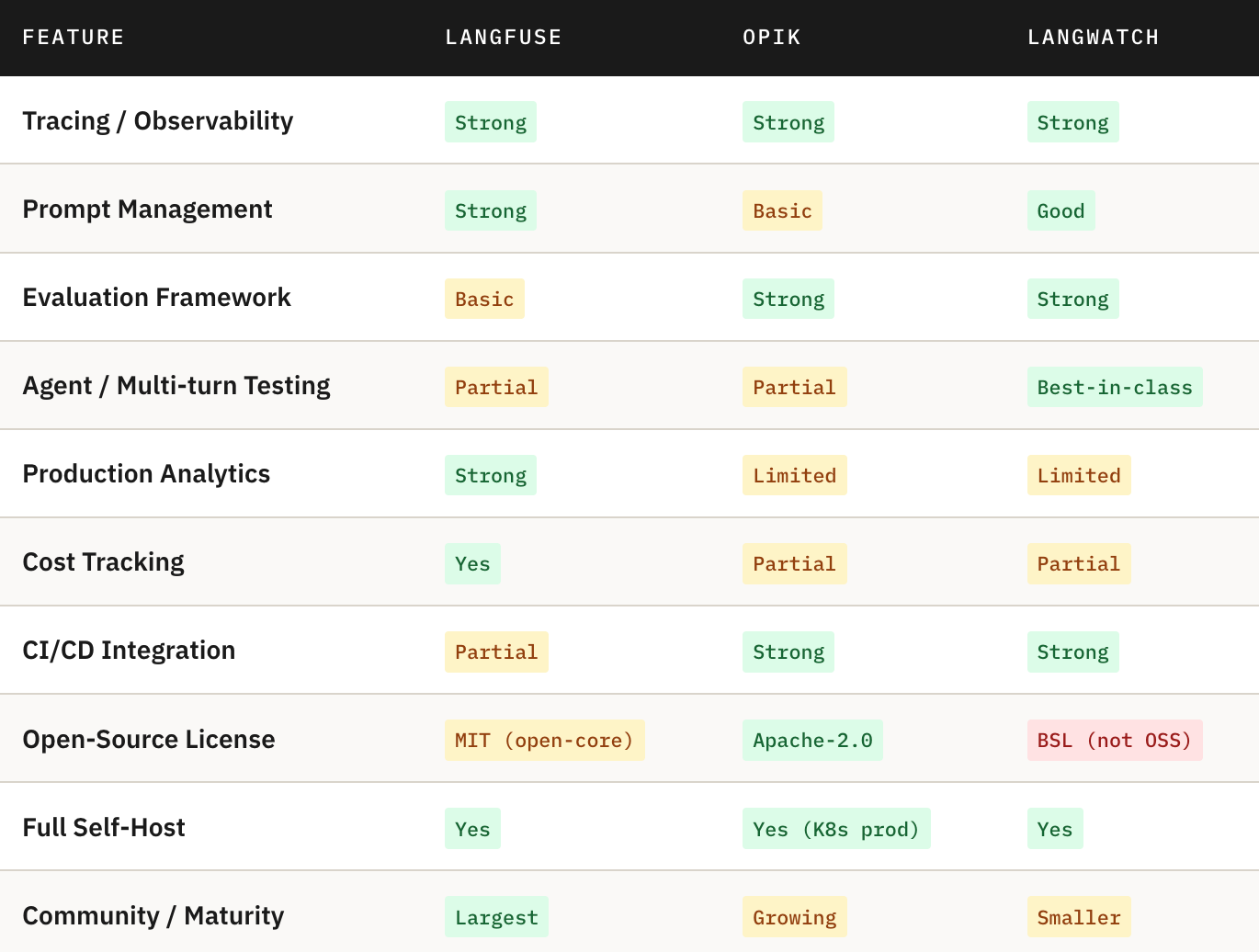
There is no single correct answer here. The right tool depends on what you’re building and what capabilities matter most to you.
If you have the infrastructure capacity and need a battle-tested platform with strong prompt management, production analytics, and a large community, Langfuse is the safer choice.
If your priority is evaluation automation such as running evals and testing prompts like unit tests and you are comfortable with a still maturing product, Opik is a strong option.
And if you’re building multi turn agentic systems and in need of simulation based testing along with a more lightweight infrastructure footprint, Langwatch is the better fit.
A few cross-cutting considerations that apply regardless of which tool you pick:
If data residency matters to you, all three support full self-hosting with no mandatory external connectivity. However, Opik’s default telemetry collection and Langwatch’s BSL license both require a closer look before committing in regulated environments.
If you’re just getting started, Langfuse’s larger community and documentation (despite its imperfections) means more answered questions on Stack Overflow and Reddit. For a new team with no existing tooling, that path-of-least-resistance advantage is real.
If you’re cost-sensitive on infrastructure, Langwatch’s footprint is genuinely smaller. But don’t conflate lightweight with feature-poor. For agent-focused teams, Langwatch’s simulation testing may be more valuable than Langfuse’s analytics depth.
Today, Opik has matured considerably, Langwatch has carved out a clear niche in agent testing, and several other platforms (Arize Phoenix, Braintrust, Lunary) have also become credible options depending on your use case.
What’s clear from community discussions and real-world usage is that these tools are starting to diverge in their focus rather than converging on the same feature set.
Langfuse is doubling down on being a comprehensive production observability platform. Opik is leaning into evaluation automation and developer-focused testing workflows. Langwatch is betting on agentic simulation as the key quality challenge for the next wave of LLM applications.
All of these platforms are solid choices. The key is to pick the one that aligns with where your team’s actual pain points are.


Orbislabs AI 2026. All Rights Reserved.


