< Research
December 18, 2025


As agentic AI becomes more popular, organizations need to find a suitable platform to adopt LLM workflows that:
Whether you’re building an internal AI assistant, a multi-agent decision support tool, or a public-facing chatbot platform, understanding these capabilities early helps avoid lock-ins or costly rebuilds.
1- Open-source licensing with freedom for commercial use and white-labeling
2- Multi-user support and RBAC (role-based access control)
3- Agent type: chatbot, RAG, web scraping, automation
4-Python compatibility (since our team primarily works with Python)
5-Ease of UI / UX for quick prototyping and collaboration
6-Monitoring, logs, and observability for scale
7-Custom integration support with APIs and vector DBs
8- Long-term flexibility and active community support
With these criteria in mind, I began searching platforms and conducted a detailed analysis of three of the most prominent AI orchestration platforms to build multi-agent LLM workflows:
I evaluated these platforms based on technical, operational, and business-readiness criteria — including licensing, agent flexibility, scalability, and enterprise-level deployment features.
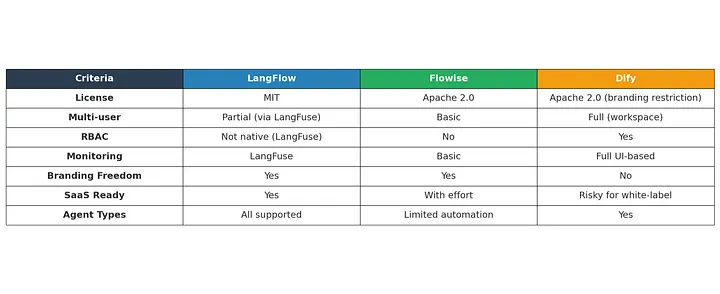
Among all the options, Dify was the platform that initially stood out with its user-friendly interface and extensive built-in features. It has a powerful UI, agent support, monitoring, and workspace-based RBAC.
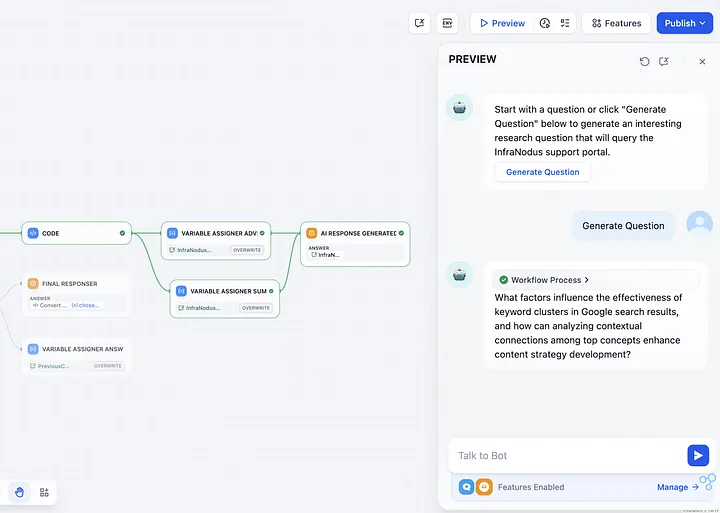
Even if it checked almost all of our technical and functional criteria initially, it had a catch. As I explored Dify more, I encountered several issues regarding licensing constraints, especially when considering white-label SaaS use cases. That became an immediate red flag for us since further integration and customization would bring significant legal complexity, which didn’t align with our long-term objectives. Branding removal requires a commercial license, and the OSS version comes with attribution constraints.
After careful consideration, we have decided that Dify wasn’t the right fit.
I moved on to two fully open-source alternatives: Flowise and LangFlow. Both open-source platforms with clean, intuitive interfaces. I have tested them with real-world cases and found that both platforms were surprisingly easy to work with, even when I was exploring them for the first time. Both were actively maintained, had strong communities, and offered visual flow editors for building LLM-powered agents.
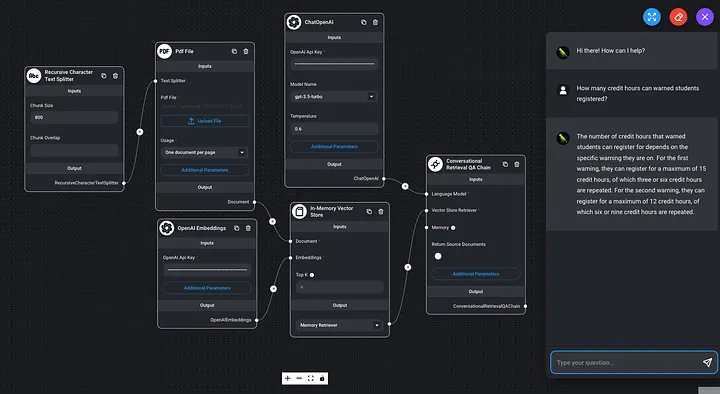

Flowise offers a great experience for internal projects, especially for JS-heavy projects or quick MVPs. But LangFlow felt like a better fit for my team. As a Python-based team, we found it much easier to integrate our own components.
Beyond that, Langflow has a more flexible and open structure to have further development. While it requires some extra work to implement features like multi-user access and role-based access permissions, I found the overall experience more natural and comfortable.
As I gained more hands-on experience, I discovered more helpful UI shortcuts and developed a deeper understanding of the building blocks of the platform.
Another major aspect of using Langflow is that it is backed by a growing and active open-source community, and unlike some other platforms, it does not pose licensing issues. Langflow offered us full control with a strong technical foundation and the freedom to build our own improvements. Even though it did not check all of our criteria initially, its adaptability allows us to shape the platform into exactly what we need for the long run.


Orbislabs AI 2026. All Rights Reserved.


